The fundamental objects of study in higher-order Fourier analysis are nilmanifolds, or in other words spaces given as a quotient  of a connected nilpotent Lie group
  by a discrete cocompact subgroup
  . Starting with Furstenberg’s work on Szemeredi’s theorem and the multiple recurrence theorem, work by Host and Kra, Green and Tao, and several others has gradually established that nilmanifolds control higher-order linear configurations in the same way that the circle, as in the Hardy-Littlewood circle method, controls first-order linear configurations.
Of basic importantance in the study of nilmanifolds is equidistribution: one needs to know when the sequence  equidistributes and when it is trapped inside a subnilmanifold. It turns out that this problem was already studied by Leon Green in the 60s. To describe the theorem note first that the abelianisation map
  induces a map from to a torus
  which respects the action of , and recall that equidistribution on tori is well understood by Weyl’s criterion. Leon Green’s beautiful theorem then states that equidistributes in the nilmanifold if and only if its image in the torus equidistributes.
Today at our miniseminar, Aled Walker showed us Parry’s nice proof of this theorem, which is more elementary than Green’s original proof. During the talk there was some discussion about the importantance of various hypotheses such as “simply connected” and “Lie”. It turns out that the proof works rather generally for connected locally compact nilpotent groups, so I thought I would record the proof here with minimal hypotheses. The meat of the argument is exactly as in Aled’s talk and, presumably, Parry’s paper.
Let be an arbitrary locally compact connected nilpotent group, say with lower central series

and let  be a closed cocompact subgroup. Under these conditions the Haar measure
  of induces a -invariant probability measure
  on . We say that
  is equidistributed if for every
  we have

We fix our attention on the sequence

for some  and
and  . As before we have an abelianisation map

from the -space to the compact abelian group  . We define equidistribution on similarly. The theorem is then the following.
Theorem 1 (Leon Green’s theorem) For and the following are equivalent.
- The sequence is equidistributed in .
- The sequence
 is equidistributed in .
- The orbit of
 is dense in .
-
 for every nontrivial character
  .
.
Item 1 above trivially implies every other item. The implication 4 3 (a generalised Kronecker theorem) follows by pulling back any nontrivial character of
  . The implication 32 (a generalised Weyl theorem) follows from the observation that every weak* limit point of the sequence of measures

]must be shift-invariant and thus equal to the Haar measure. So the interesting content of the theorem is 21.
A word about the relation to ergodicity: By the ergodic theorem the left shift  is ergodic if and only if for almost every
  the sequence equidistributes; on the other hand
  is uniquely ergodic, i.e., the only -invariant measure is the given one, if and only if for every the sequence equidistributes. Thus to prove the theorem above we must not only prove that is ergodic but that it is uniquely ergodic. Fortunately one can prove these two properties are equivalent in this case.
Lemma 2 If  is ergodic then it’s uniquely ergodic.
The following proof is due to Furstenberg.
Proof: By the ergodic theorem the set  of -generic points, in other words points for which

for every , has -measure  , and clearly if
  and
and  then
then  , so
, so  , where
  is the projection of onto
  .
.
Now let  be any -invariant ergodic measure. By induction we may assume that
  is uniquely ergodic, so we must have
  , so
, so

But by the ergodic theorem the set of -generic points must also have -measure , so there must be some point which is both – and -generic, and this implies that  .
. 
We need one more preliminary lemma about topological groups before we really get started on the proof.
Lemma 3 If  and
and  are connected subgroups of some ambient topological group then
 ![{[H,K]}](https://s0.wp.com/latex.php?latex=%7B%5BH%2CK%5D%7D&bg=ffffff&fg=000000&s=0&c=20201002) is also connected.
is also connected.
Proof: Since ![{(h,k)\mapsto [h,k]=h^{-1}k^{-1}hk}](https://s0.wp.com/latex.php?latex=%7B%28h%2Ck%29%5Cmapsto+%5Bh%2Ck%5D%3Dh%5E%7B-1%7Dk%5E%7B-1%7Dhk%7D&bg=ffffff&fg=000000&s=0&c=20201002) is continuous certainly
is continuous certainly ![{C = \{[h,k]:h\in H,k\in K\}}](https://s0.wp.com/latex.php?latex=%7BC+%3D+%5C%7B%5Bh%2Ck%5D%3Ah%5Cin+H%2Ck%5Cin+K%5C%7D%7D&bg=ffffff&fg=000000&s=0&c=20201002) is connected, so
is connected, so  is also connected, so because
  for all
  we see that
 ![{[H,K]=\bigcup_{n=1}^\infty C^n}](https://s0.wp.com/latex.php?latex=%7B%5BH%2CK%5D%3D%5Cbigcup_%7Bn%3D1%7D%5E%5Cinfty+C%5En%7D&bg=ffffff&fg=000000&s=0&c=20201002) is connected.
is connected.
Thus if is connected then every term  in the lower central series of is connected.
We can now prove Theorem 1. As noted it suffices to prove that acts ergodically on whenever it acts ergodically on . By induction we may assume that acts ergodically on . So suppose that  is -invariant. By decomposing
  as a
as a  -space we may assume that
  obeys
obeys

for some character  . In particular
  is both
  -invariant and -invariant, so it factors through a -invariant function
  , so it must be constant, say . Moreover for every
  the function

is -invariant, and also a eigenvector:
![\displaystyle \Delta_bf(gx) = \gamma([b,g])\Delta_bf(x).](https://s0.wp.com/latex.php?latex=%5Cdisplaystyle+%5CDelta_bf%28gx%29+%3D+%5Cgamma%28%5Bb%2Cg%5D%29%5CDelta_bf%28x%29.&bg=ffffff&fg=000000&s=0&c=20201002)
By integrating this equation we find that either ![{\gamma([b,g])=1}](https://s0.wp.com/latex.php?latex=%7B%5Cgamma%28%5Bb%2Cg%5D%29%3D1%7D&bg=ffffff&fg=000000&s=0&c=20201002) , so
, so  is constant, or
  , so either way we have
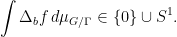
But since  is a continuous function of
  and equal to when
  we must have for all sufficiently small , and thus for all by connectedness of
  and the identity
![\displaystyle [b_1b_2,g]=[b_1,g][b_2,g].](https://s0.wp.com/latex.php?latex=%5Cdisplaystyle+%5Bb_1b_2%2Cg%5D%3D%5Bb_1%2Cg%5D%5Bb_2%2Cg%5D.&bg=ffffff&fg=000000&s=0&c=20201002)
Thus setting  extends
  to a homomorphism
  . In fact we can extend still further to a function
  , where
  is the unit disc in
  , by setting

Now if  and then

and

so
![\displaystyle \gamma(b)\gamma(a)=\gamma(ab)=\gamma(ba[a,b]) = \gamma(ba)\gamma([a,b])=\gamma(b)\gamma(a)\gamma([a,b]).](https://s0.wp.com/latex.php?latex=%5Cdisplaystyle+%5Cgamma%28b%29%5Cgamma%28a%29%3D%5Cgamma%28ab%29%3D%5Cgamma%28ba%5Ba%2Cb%5D%29+%3D+%5Cgamma%28ba%29%5Cgamma%28%5Ba%2Cb%5D%29%3D%5Cgamma%28b%29%5Cgamma%28a%29%5Cgamma%28%5Ba%2Cb%5D%29.&bg=ffffff&fg=000000&s=0&c=20201002)
Since  we can cancel
  , so
, so
![\displaystyle \gamma(a)(\gamma([a,b])-1) = 0.](https://s0.wp.com/latex.php?latex=%5Cdisplaystyle+%5Cgamma%28a%29%28%5Cgamma%28%5Ba%2Cb%5D%29-1%29+%3D+0.&bg=ffffff&fg=000000&s=0&c=20201002)
Finally observe that  is a continuous function of
  , and
, and  , so we must have
 ![{\gamma([a,b])=1}](https://s0.wp.com/latex.php?latex=%7B%5Cgamma%28%5Ba%2Cb%5D%29%3D1%7D&bg=ffffff&fg=000000&s=0&c=20201002) for all sufficiently small , and thus by connectedness of and the identity
for all sufficiently small , and thus by connectedness of and the identity
![\displaystyle [a_1a_2,b]=[a_1,b][a_2,b]](https://s0.wp.com/latex.php?latex=%5Cdisplaystyle+%5Ba_1a_2%2Cb%5D%3D%5Ba_1%2Cb%5D%5Ba_2%2Cb%5D&bg=ffffff&fg=000000&s=0&c=20201002)
we must have identically. But this implies that vanishes on all  -term commutators and thus on all of , so in fact factors through , so it must be constant. This finishes the proof.
A remark is in order about the possibility that some of the groups  and
and  are not closed. This should not matter. One could either read the above proof as it is written, noting carefully that I never said groups should be Hausdorff, or, what’s similar, instead modify it so that whenever you quotient by a group you instead quotient by the group
  .
.
Embarrassingly, it’s difficult to come up with a non-Lie group to which this generalised Leon Green’s theorem applies. It seems that many natural candidates have the property that is not connected but is: for example consider
![\displaystyle \left(\begin{array}{ccc}1&\mathbf{R}\times\mathbf{Q}_2&\mathbf{R}\times\mathbf{Q}_2\\0&1&\mathbf{R}\times\mathbf{Q}_2\\0&0&1\end{array}\right)/\left(\begin{array}{ccc}1&\mathbf{Z}[1/2]&\mathbf{Z}[1/2]\\0&1&\mathbf{Z}[1/2]\\0&0&1\end{array}\right).](https://s0.wp.com/latex.php?latex=%5Cdisplaystyle++%5Cleft%28%5Cbegin%7Barray%7D%7Bccc%7D1%26%5Cmathbf%7BR%7D%5Ctimes%5Cmathbf%7BQ%7D_2%26%5Cmathbf%7BR%7D%5Ctimes%5Cmathbf%7BQ%7D_2%5C%5C0%261%26%5Cmathbf%7BR%7D%5Ctimes%5Cmathbf%7BQ%7D_2%5C%5C0%260%261%5Cend%7Barray%7D%5Cright%29%2F%5Cleft%28%5Cbegin%7Barray%7D%7Bccc%7D1%26%5Cmathbf%7BZ%7D%5B1%2F2%5D%26%5Cmathbf%7BZ%7D%5B1%2F2%5D%5C%5C0%261%26%5Cmathbf%7BZ%7D%5B1%2F2%5D%5C%5C0%260%261%5Cend%7Barray%7D%5Cright%29.+&bg=ffffff&fg=000000&s=0&c=20201002)
So it would be interesting to know whether the theorem extends to such a case. Or perhaps there are no interesting non-Lie groups for this theorem, which would be a bit of a let down.
is an open subgroup of
.


![{[G,G]}](https://s0.wp.com/latex.php?latex=%7B%5BG%2CG%5D%7D&bg=ffffff&fg=000000&s=0&c=20201002)





![{[F,F]}](https://s0.wp.com/latex.php?latex=%7B%5BF%2CF%5D%7D&bg=ffffff&fg=000000&s=0&c=20201002)
![{[,]:F\times F\rightarrow[F,F]}](https://s0.wp.com/latex.php?latex=%7B%5B%2C%5D%3AF%5Ctimes+F%5Crightarrow%5BF%2CF%5D%7D&bg=ffffff&fg=000000&s=0&c=20201002)
![{[F,1]=1}](https://s0.wp.com/latex.php?latex=%7B%5BF%2C1%5D%3D1%7D&bg=ffffff&fg=000000&s=0&c=20201002)
![{[F,U]=1}](https://s0.wp.com/latex.php?latex=%7B%5BF%2CU%5D%3D1%7D&bg=ffffff&fg=000000&s=0&c=20201002)

then there is a finite group
there is a finite group
of commuting probability
.








![{[G,G]\rightarrow [H,H]}](https://s0.wp.com/latex.php?latex=%7B%5BG%2CG%5D%5Crightarrow+%5BH%2CH%5D%7D&bg=ffffff&fg=000000&s=0&c=20201002)
![{[,]:G/Z(G)\times G/Z(G)\rightarrow[G,G]}](https://s0.wp.com/latex.php?latex=%7B%5B%2C%5D%3AG%2FZ%28G%29%5Ctimes+G%2FZ%28G%29%5Crightarrow%5BG%2CG%5D%7D&bg=ffffff&fg=000000&s=0&c=20201002)
![{Z(H)\leq [H,H]}](https://s0.wp.com/latex.php?latex=%7BZ%28H%29%5Cleq+%5BH%2CH%5D%7D&bg=ffffff&fg=000000&s=0&c=20201002)


![{[E,E]\cong [F,F]}](https://s0.wp.com/latex.php?latex=%7B%5BE%2CE%5D%5Ccong+%5BF%2CF%5D%7D&bg=ffffff&fg=000000&s=0&c=20201002)
![{Z(E)\leq [E,E]}](https://s0.wp.com/latex.php?latex=%7BZ%28E%29%5Cleq+%5BE%2CE%5D%7D&bg=ffffff&fg=000000&s=0&c=20201002)

 Random Permutations