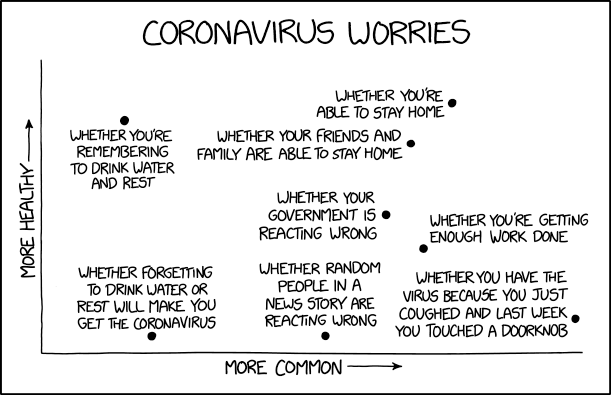
This is a research blog, but it is hard to think about much other than coronavirus in this unique time. Here are some thoughts.
Some extreme fears:
Let’s get these out of the way first.
- People keep greedily stock-piling and vulnerable people go without necessary resources, or people get injured in the frenzy. More generally, I am worried about panic, mob mentality, riots, looting, etc.
- Blame. Blame China for creating the thing, blame the government for mismanaging, blame your neighbour for infecting you, blame the stockpilers (see point 1).
- Social distance. Not in the sense of infection control (see wikipedia), which is practical and good, but in a more general sense of developing selfishness, nationalism, every-man-for-himself-ism, the opposite of solidarity. A unique feature of the current crisis is that our usual mechanisms for showing unity are mostly compromised.
- Tip of the iceberg: maybe this is just phase 1, and the virus will keep mutating and mutating, and who knows what will happen.
More concretely, and most obviously, I am worried about the safety of people I know. I will leave “how to think about the risk” for some other time (or some other author).
An extreme hope: virtual connectivity
It sounds frivolous compared to my list of fears, but just now it’s one of my big hopes for humans. In this era of technology we deserve to be much better at this. The only reason I don’t use Skype more is the technology seems just slightly crap, e.g., with dropped or slow connections, or the interaction is just slightly clumsy, with the natural timing of conversation out of step. The current crisis could drive change here: technologically, much like how war invented the microwave, but also just by forcing us to practice and develop the social protocol.
Why do I consider that important? Because I think it’s a key step for us as a global society to travel less, and traveling less will not only slow the spread of disease but also help to slow climate change, which after all is still a much greater existential threat to the race, but lacks (at least for now) the shock-and-awe necessary to generate a collective response.
In short, I am hoping that a global crisis like the current one compels us to develop tools quickly that we are going to need anyway, and virtual connectivity is my big example.
A message from Queens’ College Acting Senior Tutor
I liked this message from Queens’ College Acting Senior Tutor, Prof Martin Dixon, to students, a much-needed message of responsibility and leadership:
Equally, do not underestimate the positive impact that you can make. Perhaps you may not realise, but being a student at Cambridge causes people to hold you in high regard. Your words and actions will be listened to and watched. You are among the very best students in the world, and you can lead by example. A kind word, a simple act of support, a calming of panic, can have a profound effect on those around you. You may not want this responsibility, but you have it. You also have the opportunity to demonstrate what it means to be a Cambridge student in a time of uncertainty. Please live up to the faith we have in you.
Source: the tab, Emily Hyde & Claudia Rowan, 2020/03/13
Of course, the message applies much more broadly than to just students at Cambridge. Anybody with any sort of visible status has the responsibility to think calmly and critically in this time of crisis, as their decisions and opinions are more liable to influence and spread.
Isaac Newton and the black death
Yes, Isaac Newton invented calculus, optics, gravity, etc, etc, during the great plague (1665–1666), the last major recurrence of bubonic plague in England. Therefore, so says everybody recently it seems, lots of excellent ground-breaking research is going to happen over the next couple of months. Maybe, but I’m not as confident. Here are some counterpoints.
- Most science is done in labs these days.
- Science that isn’t done in labs (e.g., mathematics, theoretical physics) is often about collective understanding, and sharing ideas is essential.
- Lots of people have, like, 2-year-olds at home.
- Isaac Newton didn’t have minute-by-minute updates on the progress of the disease.
More on point 2: Mathematics at its heart is often about developing collective understanding: that’s why giving talks is so cental, to give people the opportunity to interpose questions off the cuff, test their understanding, bounce ideas off each other. Reading and writing papers is an equally important part of the process, but a much slower part of the process.
Personally
Personally, my usual research is not much affected: I normally work from my office at home and collaborate remotely, mostly by email. In the coming months I hope to work on virtual colloquia, virtual teaching, etc. It will be interesting to see where we get to in a couple months’ or a year’s time.
Best wishes to anyone reading this. Stay safe, be sensible, don’t panic. Stay in touch.
 be a group of order
  . Is there a bijection
  such that the map
  is also a bijection?
  . Then
  , and because every element has odd order this defines a bijection. If
  , then it suffices to find a linear map without an eigenvalue. Cyclic groups of even order never have complete mappings (option 1: stop reading and try to prove this as a diverting puzzle; option 2: read on, and it will be explained and become essential).
 mutually orthogonal
  Latin squares, where two Latin squares are termed orthogonal if, when superimposed, the
  pairs of symbols are distinct. The most familiar Latin square is the cyclic Latin square, which has entries
  for
for  . More generally, for any group
  of
of  is a bijection the elements
  will sum up to zero, so
 ![{\prod G \in [G, G]}](https://s0.wp.com/latex.php?latex=%7B%5Cprod+G+%5Cin+%5BG%2C+G%5D%7D&bg=ffffff&fg=000000&s=0&c=20201002) . Hall and Paige proved that this condition is equivalent to the Sylow 2-subgroups of
. Hall and Paige proved that this condition is equivalent to the Sylow 2-subgroups of  , a group of order
  , and finally
  . We know there is at least one complete mapping as long as
  have?
have?  bijections
  has a roughly
  chance of being a bijection, so you can guess that the number of complete mappings is about
  ; this conjecture is attributed to Vardi (1991) (in a weaker form) and Wanless (2011).
 .
. 
 , where
  is the set of bijections. The usual tool for counting additive triples (or solutions to any linear equation) is Fourier analysis; hence the problem reduces to understanding the Fourier transform of
  . After barking up this tree (for quite a while), we were eventually
 (what the hell?).

 is the proportion of involutions in
  -groups have the most complete mappings of any group of the same order. We can keep going, in principle, but really we would rather not: there is a combinatorial explosion in the number of “collision types” (in a sense we make precise), and to give the next term in the asymptotic you need to sum over all of these.
  and all nontrivial complex representations of
  , then
  such). By combining a few such effective statements, we can cover all the simple sporadic groups, apart from the two smallest
  and
and  . You can view this as a second-generation proof of the Evans–Bray contribution to the Hall–Paige conjecture. In fact, our proof covers all nonabelian finite simple groups except for some alternating groups, some
  , and about ten other groups that we list.

