Before continuing, prove or disprove: If 


Certainly this is the case if 


Here is a nice example: Denote the 






where, for each 


Sean Eberhard's mathematics blog
Before continuing, prove or disprove: If
Certainly this is the case if
Here is a nice example: Denote the
where, for each
A famous result: Two positive integers chosen at random will be coprime with probability 
One has to say what one means by this, since there is no uniform distribution on the positive integers. What we mean is that if we choose 


Here is one classic proof: Consider the points 





Another way of imagining a random element on a noncompact group 
so choosing an element at random from 


This does not imply the asymtotic result in 
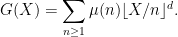
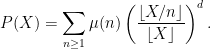
EDIT (28/4/12): As pointed out to me by Freddie Manners, the “classic proof” suggested above suffers from the fatal defect of not proving that the limit exists. Here is an alternative proof which does prove that the limit exists. More generally, let 


![{(x_1,\ldots,x_d)\in[1,X]^d}](https://s0.wp.com/latex.php?latex=%7B%28x_1%2C%5Cldots%2Cx_d%29%5Cin%5B1%2CX%5D%5Ed%7D&bg=ffffff&fg=000000&s=0&c=20201002)


for all 
Thus, the probability that 
The 



 Random Permutations