The proof presented below, giving an (almost) complete characterisation of constructible regular polygons, is such a beautiful gem of a proof that I can’t help but record it here so that I might not forget it. I’ll go over far more details than is usually done, simply because it amuses me how many different areas of undergraduate mathematics are touched upon.
Theorem 1 The regular  -gon is constructible by ruler and compass if and only if has the form
  , where
  are distinct primes of the form
  .
.
Primes of this form are called Fermat primes. The only known Fermat primes are  , and heuristics suggest that there may be no others, though this is an open problem.
We must say what we mean by “constructible”. We assume we are given a plane (a sheet of paper, say), with two points already labelled. We parameterise the plane by points of  , and we rotate and scale so that the two labelled points are
  and
and  . There are three things we are allowed to do:
- Whenever we have two labelled points we can draw the straight line through them.
- Whenever we have two labelled points we can draw the circle with one as centre and the other on the circumference.
- We can label any point of intersection (of two lines, two circles, or a line and a circle).
Any point of the plane (considered as an element of ) that can be labelled through a sequence of the above operations is called constructible. Denote by  the set of constructible numbers.
Lemma 2 The set  is the smallest subfield of closed under taking square roots.
The lemma can be proved as follows.
- Show closure under
 by constructing the parallelogram with vertices
  .
.
- Show closure under the rotation
 .
.
- Show closure under taking real parts. Hence
 , where
  .
.
- Show closure under
 for
for  by constructing the right triangle with leg lengths
  and the similar right triangle with base
  . Deduce that is a ring.
- Show that if
 then
then  by doing so first for
  (another right triangle construction) and then using
  . Thus is a field.
- Show that
 is closed under taking square roots (yet another right triangle construction). Thus show that is closed under taking square roots by bisecting an appropriate angle.
- Finally show that any subfield
 of closed under taking square roots is closed under the “constructing” rules we listed when defining . The idea here is that one never has to solve an equation worse than a quadratic (when intersecting two circles, first construct the perpendicular bisector to the segment connecting the two centres, and then compute the intersection of this line with one of the circles).
The following is our algebraic characterisation of constructibility.
Lemma 3 We have  if and only if the degree
 ![{[K:\mathbf{Q}]}](https://s0.wp.com/latex.php?latex=%7B%5BK%3A%5Cmathbf%7BQ%7D%5D%7D&bg=ffffff&fg=000000&s=0&c=20201002) of the normal closure of
of the normal closure of  is a power of
  .
.
Proof: By the previous lemma, can be described as the union of all fields  such that
  for all
  . Let . Thus
  lies in some such field
  . But note by the tower law that
![\displaystyle [L:\mathbf{Q}] = \prod_{k=1}^{m} [\mathbf{Q}(\alpha_1,\ldots,\alpha_k):\mathbf{Q}(\alpha_1,\ldots,\alpha_{k-1})],](https://s0.wp.com/latex.php?latex=%5Cdisplaystyle+%5BL%3A%5Cmathbf%7BQ%7D%5D+%3D+%5Cprod_%7Bk%3D1%7D%5E%7Bm%7D%C2%A0%5B%5Cmathbf%7BQ%7D%28%5Calpha_1%2C%5Cldots%2C%5Calpha_k%29%3A%5Cmathbf%7BQ%7D%28%5Calpha_1%2C%5Cldots%2C%5Calpha_%7Bk-1%7D%29%5D%2C&bg=ffffff&fg=000000&s=0&c=20201002)
where each factor ![{[\mathbf{Q}(\alpha_1,\ldots,\alpha_k):\mathbf{Q}(\alpha_1,\ldots,\alpha_{k-1})]\leq 2}](https://s0.wp.com/latex.php?latex=%7B%5B%5Cmathbf%7BQ%7D%28%5Calpha_1%2C%5Cldots%2C%5Calpha_k%29%3A%5Cmathbf%7BQ%7D%28%5Calpha_1%2C%5Cldots%2C%5Calpha_%7Bk-1%7D%29%5D%5Cleq+2%7D&bg=ffffff&fg=000000&s=0&c=20201002) . Thus
. Thus ![{[L:\mathbf{Q}]}](https://s0.wp.com/latex.php?latex=%7B%5BL%3A%5Cmathbf%7BQ%7D%5D%7D&bg=ffffff&fg=000000&s=0&c=20201002) is a power , and by another application of the tower law so is .
is a power , and by another application of the tower law so is . 
Conversely suppose that is a power of . Then the Galois group  is a -group. Recall that any
  -group
  (except the trivial group) has nontrivial centre: by counting conjugacy class sizes, the size of
  must be divisible by . Thus by induction (and classifying abelian -groups) it follows that in every -group there is a sequence of normal subgroups
  such that
  ,
,  , and
, and  for each
  . Specialising to
  , Galois theory now implies that is the top of a tower of quadratic extensions starting from
  , so
, so  .
.
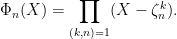
By saying “the -gon is constructible” we mean that the vertices of some regular -gon are constructible. Clearly this is equivalent to saying  is an element of . Note that
  , where the th cyclotomic polynomial
  is defined by
Note that ![{\prod_{d|n} \Phi_d(X) = X^n-1 \in \mathbf{Z}[X]}](https://s0.wp.com/latex.php?latex=%7B%5Cprod_%7Bd%7Cn%7D+%5CPhi_d%28X%29+%3D+X%5En-1+%5Cin+%5Cmathbf%7BZ%7D%5BX%5D%7D&bg=ffffff&fg=000000&s=0&c=20201002) , so by the uniqueness of polynomial division and induction we have that
, so by the uniqueness of polynomial division and induction we have that ![{\Phi_n(X) \in \mathbf{Z}[X]}](https://s0.wp.com/latex.php?latex=%7B%5CPhi_n%28X%29+%5Cin+%5Cmathbf%7BZ%7D%5BX%5D%7D&bg=ffffff&fg=000000&s=0&c=20201002) .
.
Lemma 4 is irreducible over .
Proof: Suppose  where
where  is irreducible and
  . We must show that each
  is a root of . Since some is a root of , it suffices to show that
  implies
  whenever is a prime not dividing . Towards this end, suppose that is such a prime and but
  . Then
  since
since  . Since is irreducible this implies that
  divides
  . Denoting reductions modulo by a tilde and using Freshman’s dream,
  divides
  . Thus and
  are not coprime, so
  , and thus
  , has a multiple root over
  . But this is a contradiction since and its formal derivative
  are coprime.
Thus  has minimal polynomial , and moreover
  is a normal extension. We have therefore reduced our task to finding those for which
 ![{[\mathbf{Q}(\zeta_n):\mathbf{Q}] = \deg\Phi_n = \varphi(n)}](https://s0.wp.com/latex.php?latex=%7B%5B%5Cmathbf%7BQ%7D%28%5Czeta_n%29%3A%5Cmathbf%7BQ%7D%5D+%3D+%5Cdeg%5CPhi_n+%3D+%5Cvarphi%28n%29%7D&bg=ffffff&fg=000000&s=0&c=20201002) is a power of .
is a power of .
Writing as a product of primes  with each
  , we have (OK, the details must stop somewhere)

This is a power of iff every  which occurs has
  and
and  a power of . But if
  is prime, then
  itself must be a power of , since for every odd
  we have


satisfies
for all
then
.







converges as
.


![{\theta\in[0,1]}](https://s0.wp.com/latex.php?latex=%7B%5Ctheta%5Cin%5B0%2C1%5D%7D&bg=ffffff&fg=000000&s=0&c=20201002)





.
 Random Permutations