I’ve been amusing myself with  -adic arithmetic lately: I’ve never really got to know it until now.
We are all familiar with the fact that every  gets represented in
  as a repeating decimal, or whatever your favourite base is. (Here I count terminating decimals as decimals which eventually repeat
  .) The converse is of course true as well: repeating decimals are rationals.
Is this true in  as well? That is, are the rationals precisely those -adics which are eventually repeating (in the other direction, of course)? One direction, that repeating -adics are rational, is pretty obvious: if
  and
and  then
then

is rational. What about the converse?
The converse seems trickier. How again did we do it in ? I don’t even remember: it’s one of those things that we know so fundamentally (until very recently,  was almost defined in my brain as the reals which eventually repeat) that we forget how to prove it.
Who cares how to prove it? It is true, and it says, in base , that if then there exists and such that

But hey, this implies that
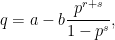
which we already know is a repeating -adic.
 is a locally compact group and that
  is a closed subgroup with an
  such that
  possesses a
  . For instance,
  ,
,  , and
, and  . The following is how you then induce a Haar measure on
  , define
  by
by 
 . Then
  , as a function of
  is supported on
  , so the above integral is finite. Moreover, if
  and
and  is compact, then
 of
of  such that
  implies
  ),
),  is continous. Since
  defined on
  is the quotient map
  , then
  , so
, so  . Finally, define
  by
by 
 is positive (in the sense that
  implies
  ), so the Riesz representation theorem guarantees the existence of a regular Borel measure
  on
on 
 Random Permutations